
Understanding the Transition from End-point Assessment to Apprenticeship Assessment


Understanding the Transition from End-point Assessment to Apprenticeship Assessment

Apprenticeship assessment reforms are changing how apprenticeship assessment is delivered across England. The Department for Education and Skills England are introducing a more flexible approach to assessment, known as apprenticeship assessment. Instead of all assessment taking place at the end of the apprenticeship, some assessment activities may now be delivered during the programme and within the training provider’s environment, where the assessment plan allows.
These changes are designed to reduce duplication, improve flexibility and create a more streamlined assessment experience, while maintaining the quality and integrity employers expect from apprenticeships.
Gateway Qualifications is supporting providers, employers and apprentices throughout this transition. Whether you’re planning ahead or preparing for delivery, we’re here to help you understand what is changing and what it means for your programmes.
Use the tracker below to see the latest status of the standards we assess and when revised assessment plans become available.
Stay up to date with the latest apprenticeship standards and assessment plans.
As Skills England publishes updated assessment plans, we review the changes and update this tracker to help you identify which standards have been revised.
Not Started
Assessment reform activity for this standard has not yet begun.
Under Review
Published
The assessment plan is being reviewed by, or has been published by, Skills England.
In Progress
We are responding to the changes and preparing our assessments.
Completed
The revised assessment plan is live and we are ready to assess apprentices.
| Standard | Level | Ref | Assessment Plan Status |
|---|---|---|---|
| Business administrator | 3 | ST0070 | Under Review |
| Team leader | 3 | ST0384 | Not Started |
| Corporate responsibility and sustainability practitioner | 4 | ST0934 | In Progress |
| Operations manager | 5 | ST0385 | Not Started |
| Customer service practitioner | 2 | ST0072 | Under Review |
| Customer service specialist | 3 | ST0071 | Under Review |
| Content creator | 3 | ST0105 | In Progress |
| Multi-channel marketer | 3 | ST1031 | Published |
| Sports coach | 4 | ST0770 | In Progress |
| Digital device repair technician | 3 | ST0682 | Published |
| Administration assistant | 2 | ST1472 | In Progress |
As apprenticeship assessment evolves, we’ve developed a clear and flexible approach that helps you choose how assessment works for your delivery. We offer options that align with your delivery model, while maintaining consistency, quality and confidence at every stage. Choose the approach that works for you...
(Centres and Gateway Qualifications assess)
(Gateway Qualifications assess)





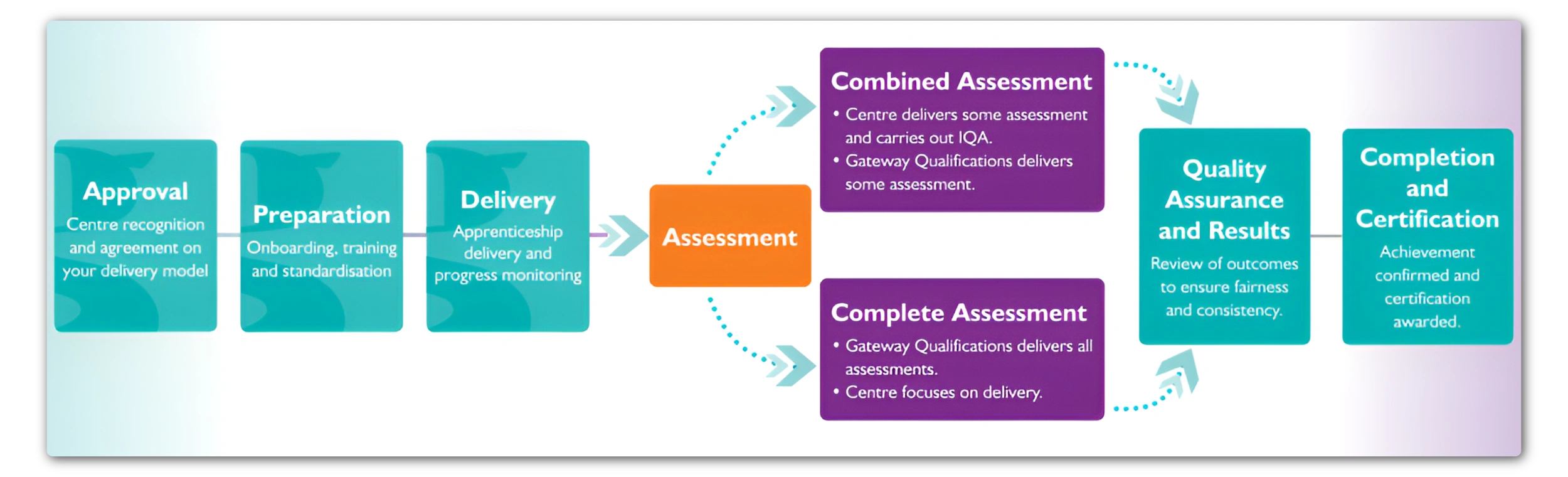
Your assessment approach is agreed upon at approval and reflected during assessment, with both routes leading to the same outcome.
Defunding announcements, apprenticeship units and standard revisions
Sixteen apprenticeship standards will be defunded as ministers look to redirect funding towards training for younger people.
Funding for the following standards will be withdrawn from 1st September 2026:
Alongside these changes, a new development has been announced. The first set of apprenticeship units will be introduced in April 2026. These units will be available on Skills England’s Apprenticeship site – filter to Apprenticeship unit.
The units are:
More detail on who these units are for, how they can be delivered, and funding arrangements is available in:
The Level 2 Administration Assistant apprenticeship standard has now been approved. It has a funding band of £4,000.
This standard is only available to learners aged 16–24 when using public funding. Starts are expected from August 2026. Despite these restrictions, high take‑up is expected.
There are currently 210 apprenticeship standards in the revision phase. Of these, 69 standards have been sent out, or are currently out for public consultation surveys.
These surveys are available on the Skills England website under Apprenticeship Surveys. This page also explains how to join the distribution list to receive information about future consultations.
There are further developments across the sector, including employer incentives and additional foundation apprenticeships in Hospitality and Retail.
More details are included in the DWP press release dated 16th March 2026: Major employment drive to help unlock 200,000 new jobs and apprenticeships for next generation – GOV.UK
Assessment plan revisions and standard version updates
On 16th December 2025, an update was released, listing the first (Group 1) standards being revised for the new version of the apprenticeship assessment plans. This list can be located on the GOV.UK website under Apprenticeship Standards: Revisions and Adjustments. The second list is due in the coming month. Signing up for email notifications of changes made to this page is highly recommended, as this is where the list will appear. Key apprenticeship standards, such as Business Administrator Level 3, can be found on this list.
A significant update to the version numbers of numerous standards occurred in December 2025. This is due to the alignment of Ofqual and Skills England on the Sector Subject Area (SSA) codes. Due to these version changes, we will see an end date to new starts for the previous version and a date for new starts on the current version. This will mean significant system and paperwork changes for all EPAOs/Assessment Organisations. Bear with your EPAO/AO on this and make sure to check that the version you are registering apprentices on with your EPAO/AO is the correct one, matching the version on your ILR. You can find out which standard is under a new version and the updated SSA code on the Skills England Apprenticeship Finder. Click on the ‘Download a list of Apprenticeships’ button.
Skills England has released updates to two guidance documents:
New information was released from Skills England, the Department for Education, and Ofqual.
We have been carefully reviewing all the information released and are working on our next steps towards implementing the reformed apprenticeship assessment practices.
Initial information
The release of three revised apprenticeship standards to the new assessment plans:
Assistant accountant | Skills England
Data technician | Skills England
Early years educator | Skills England
Two standards have been placed on hold for the revised assessment plans: Adult Care Worker and Carpentry and Joinery.
Skills England has released the draft (in development) of the new assessment plan structure
Under the new assessment plan, one assessment method will be set as mandatory. Providers will then be able to choose from a range of optional additional methods. It is the responsibility of each Apprenticeship Assessment Organisation/Awarding Organisation (AAO/AO) to decide which assessment methods they will offer for each standard. They are also responsible for the design, development, delivery and quality assurance of those methods.
The Department for Education published the Changes to Apprenticeship Assessment 2025 to 2026 document. This is commonly referred to as the companion document and is designed to be read alongside the funding rules, assessment plans and other relevant guidance.
Skills England has emphasised that employers will continue to play a central role by providing occupational and sector expertise. To support this, they plan to involve a wider range of stakeholders through the creation of a new ‘Expert Pool’.
An indicative timeline was shared outlining when changes to assessment plans will take place. It also confirmed that Group 1 will be prioritised, focusing on standards aligned with the Industrial Strategy.
Ofqual has published the responses to its consultation on the regulatory framework for apprenticeship assessment, which was carried out earlier in the year.
Alongside this, the Technical Consultation on the Regulatory Framework for Apprenticeship Assessment was launched, supported by the accompanying document Regulatory Framework for Apprenticeship Assessment: Conditions, Requirements and Guidance.
Additional guidance and conditions documents from Ofqual were released at the same time to support both consultations.
This includes the Apprenticeship Assessment Qualification Level Guidance, which underpins the General Conditions of Recognition and the Apprenticeship Assessment Qualification Level Conditions.
Providers are encouraged to respond to Ofqual’s technical consultation in due course.
Next Steps
Assessment reform rollout and regulatory consultations
Collaboration across the sector is essential, and the apprentice must remain at the heart of all changes. We are committed to supporting providers, employers, and learners through clear communication and practical guidance.
We will continue to update stakeholders as more information becomes available.
Stay informed
The Department for Education, Skills England and the Department for Work and Pensions aim to make assessment more proportionate, remove unnecessary duplication, and allow for on-programme and centre-based assessment where appropriate.
Assessment plans are expected to be shorter and more focused, with fewer assessment methods, enabling greater use of technology.
The changes intend to make apprenticeships more accessible and meaningful for employers and learners.
Assessment plans will fall into three categories:
New assessment plans are trialled against five standards.
The five standards are: Assistant Accountant, Adult Care Worker, Data Technician, Early Years Educator, and Carpentry and Joinery.
At the same time, the companion document from DfE should be read alongside the funding. The companion document intends to help providers, employers, and assessment organisations understand the key changes to aid implementation of the changes. These two pieces of the puzzle should give clarity and direction. However, there are still things we can do in the interim.
Philippa Farrell, Director of Awarding at Gateway Qualifications, emphasised the importance of robust processes to ensure fairness and consistency, stating:
“It will be a regulatory requirement for us to develop a documented assessment strategy for each standard or a comparable group of standards. We already have these in place for other qualifications. It gives the rationale as to what we are assessing, how we are assessing, how the content will be covered, what the quality assurance arrangements will be, our approach to standard setting and awarding, what are the risks to the delivery of that qualification or that standard. So the assessment strategies are our basis for our processes and our requirements, our control mechanism to ensure consistency and fairness for the delivery of that standard.”
Ofqual has recently consulted on a new regulatory framework for apprenticeship assessment, with further technical consultation expected in Autumn 2025 and new regulations expected in Spring 2026.
DfE Principles, assessment changes, risks and opportunities
Attendees of the webinar identified both risks and opportunities in the proposed changes. Key concerns included maintaining consistency and quality, managing communication, and ensuring robust quality assurance. However, panellists also saw opportunities for greater collaboration, flexibility, and more inclusive assessment practices.
The panel advised providers to:
The reforms aim to make apprenticeship assessment more flexible, proportionate and to remove duplication. Depending on the assessment plan, some assessment activities may take place throughout the programme rather than solely at the end. This can create a more integrated learner journey, while maintaining the quality, consistency and rigour of assessment.
Gateway to Completion is the final checkpoint at the end of an apprenticeship where the employer and training provider confirm that the apprentice has met all mandatory requirements and is ready to complete their apprenticeship and receive their certificate.
Traditionally, Gateway was the point at which an apprentice transitioned from on-programme learning into their End-point Assessment (EPA). However, some apprenticeship standards now include assessment earlier in the programme or use integrated assessment models. Because assessment does not always happen solely at the end, the term “Gateway to Completion” is now used to describe the final readiness check that must still take place before an apprenticeship can be certificated.
Providers may be able to assess and IQA elements of the standard. This will mean the relationship with the Assessment Organisation will need to change.
Providers will become a Centre and need a Centre Agreement in place. The Assessment Organisation will become the Awarding Organisation. The Provider will be subject to the Awarding Organisations’ quality assurance practices and all requirements for carrying out assessments and IQA.
Whether a provider can assess and quality assure any part of the apprenticeship assessment will be determined by the Awarding Organisation. Communication, collaboration and standardisation are key in determining these approaches.
Employers are responsible for verifying that apprentices have sufficiently demonstrated the behaviours outlined in the occupational standard. Evidence of this must be made available to the Awarding Organisation for Gateway to Completion.
This all started during National Apprenticeship Week, Februrary 2025.
This is all going to be implemented in phases with:
Implementation dates vary by apprenticeship standard. Use the tracker above to see the latest status.
No, unless there is a justifiable industry requirement.
Details on this can be found in the Changes to apprenticeship assessment, 2025 to 2026 document for the Department for Education.
While assessment methods are evolving, the core principles of apprenticeships remain the same.
Whether you’re delivering existing apprenticeship standards or planning for future starts, our team can help you understand the changes and prepare with confidence.
Contact Our Team
