

Access to Higher Education has always been more than a qualification. It is a bridge that enables adults to step into higher education, employment and beyond, often whilst managing the complexities of work, family, health or financial pressures.
At our recent Decoding Access to HE event, providers, sector partners and the regulator came together to reflect on how that bridge is evolving and what the next phase means for providers and learners alike.
Hosted in collaboration with QAA and sector leaders, the event explored a pivotal year of change for Access to HE, set against a shifting policy, skills and lifelong learning landscape. The conversations were candid, data‑driven and future‑focused, underpinned by a shared commitment to widening participation and awareness of the Diploma as well as raising the aspirations and achievements of those who study the qualification.
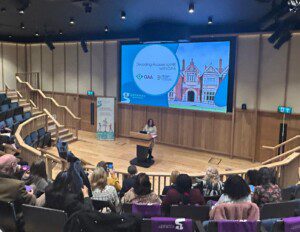
Gateway Qualifications presenting at the Access to HE event at Bletchley Park
From rules to principles: reshaping regulation
Jenny Allen from QAA focused her session on how regulation of the Diploma is changing, with the transition to a principles‑based regulatory approach. This marks a significant shift away from highly prescriptive rules towards clearer expectations grounded in outcomes, quality and trust.
The move from 118 detailed criteria to 22 core conditions reflects a desire to simplify regulation while strengthening accountability. Rather than focusing on compliance for its own sake, the new framework asks a more fundamental question: Does this system support learners to succeed and progress?
This approach places greater emphasis on:
- anticipating and managing risk
- supporting providers to comply confidently
- reducing unnecessary regulatory burden
- maximising learner success
Crucially, it also provides a regulatory culture with the flexibility for AVAs to approach aspects of their business in different ways.
What the data is telling us
Data shared during the event reinforced the continuing relevance and scale of Access to HE. With over 34,000 learners registered across 256 providers and nearly 1,200 courses, the Diploma remains a vital national pathway for adults into higher education.
However, the data also invites more profound reflection. Changes in registrations, achievement rates and grading profiles prompt important questions about consistency, equity and the learner experience. Patterns in age, ethnicity, disability and disadvantage highlight both the strengths of Access to HE as a widening participation route and the persistent inequalities that still need addressing.
Rather than offering easy answers, the data acts as a catalyst, encouraging providers and regulators alike to use evidence more intelligently to inform improvement, challenge assumptions, and shape future practice.
Quality, trust and the “gold standard”
Alongside regulatory reform, the event reinforced the importance of quality assurance as a connected system, rather than a set of isolated checks. High‑quality Access to HE delivery relies on alignment between diploma specifications, rules of combination, assessment plans, assignment briefs and grading decisions.
This “quality chain” approach reframes quality not as something inspected at the end, but as something designed in from the start. When documentation, assessment practice and internal verification are coherent, learners benefit from clarity, fairness and confidence in the grading process.
The emphasis throughout was on doing fewer things better, strengthening understanding of key documents, embedding robust internal processes, and ensuring assessment decisions are valid, consistent and transparent.
Raising the bar through innovative practice
The event also highlighted how innovative curriculum and teaching practices can transform learner engagement and motivation.
Examples shared included project‑based learning, strong industry links, digital learning approaches and initiatives designed to foster belonging and aspiration. These practices recognise that Access to HE learners bring rich life experience and that teaching approaches must be flexible and empowering.
By connecting learning more explicitly to future pathways, employment contexts and higher education expectations, providers can help learners see Access to HE as a launchpad.

Discussion panel at Access to HE event at Bletchley Park
Why Access to HE matters more than ever
As policy conversations increasingly focus on skills, lifelong learning and progression, Access to HE occupies a uniquely important position. It supports adults who may have been excluded from traditional routes, equipping them with both subject knowledge and the confidence to succeed in higher education.
The event underscored a collective opportunity to amplify the national profile of Access to HE, strengthen its visibility within HE admissions, and ensure it is recognised as a cornerstone of an inclusive post‑16 system. The event also explored the opportunities to work with younger learners by exception. Many providers were unaware that 16-18 year olds can also take Access to HE diplomas where they are unable to access traditional A Levels.
Access to HE is at a moment of renewal
With relicensing underway, grading reforms bedding in, and a renewed focus on evidence and impact, the sector has a chance to shape what excellence looks like for the next generation of adult learners.
By working collaboratively — providers, AVAs and regulators together — Access to HE can remain relevant and indispensable.