

The Apprenticeships and Training Conference 2026 brought together providers, policymakers, employers and sector leaders for two days of insight and discussion in Liverpool. The event highlighted both the ambition within the skills sector and the scale of the work required to deliver a more agile and future-ready skills system. While conversations acknowledged the economic pressures shaping the current landscape, the focus remained firmly on how apprenticeships, technical education and workforce development must evolve in the years ahead.
A New Direction for Funding and Skills Flexibility
Baroness Smith opened the conference with a strong message about the future of skills funding. She emphasised the need for greater flexibility in the growth and skills levy, allowing it to support short courses aligned to national infrastructure priorities. A key ambition was the introduction of a three-month approval timeline for new training provision, reflecting the Government’s desire to speed up reform.
 The government is doubling down on skills as a national priority, with investments in construction, engineering, defence, and digital and AI. A programme of free AI foundations training formed part of this wider ambition to prepare the workforce for rapid technological change. While delegates welcomed the somewhat limited strategic clarity, many expressed concerns about sustained pressure on FE budgets, the speed of reform, and the risk of market instability without additional support. Worries were raised about the levy top slice and ESOL funding cuts in devolved areas, which may further impact providers already operating under significant financial strain.
A Renewed Focus on Young People and NEETs
The rising number of young people not in education, employment or training (NEETs) shaped much of the discussion. The term “pivot” surfaced repeatedly across sessions, reflecting a sector-wide recognition of the need to shift attention towards those most at risk of disengagement.
Baroness Smith reiterated several measures already planned to strengthen youth engagement with apprenticeships. These include full Government funding for apprenticeships for under-25s in SMEs, employer incentives to take on young apprentices, and a pilot Apprenticeship Clearing System to match unplaced candidates with employer vacancies. The expansion of Foundation Apprenticeships into Hospitality and Retail also aims to widen access to sector-relevant pathways.
Skills England reinforced the urgency of this agenda, with the Joint Chief Executive Officer, Sarah MacLean, highlighting data showing that over one million young people are currently NEET. She stressed the need for clearer progression routes, stronger pre‑employment support and more effective early guidance to help young people move into training or work. Delegates agreed, while also emphasising that efforts to tackle NEET levels must not come at the expense of adult learners, whose skills remain vital to the economy.
Her session also confirmed that occupational standards remain the “bedrock” of technical education. She set out Skills England’s wider priorities, including faster approval of apprenticeship standards, a new AI Skills Framework, and a forthcoming Level 4 AI and Automation Apprenticeship. She also stressed the importance of aligning national priorities with local labour‑market needs, supported by updated Local Skills Improvement Plans.
Spotlight on Inclusion and Digital Capability
The Ofsted Inclusion workshop highlighted how inclusion now sits at the heart of the FE and Skills inspection framework, with providers encouraged to review leadership, curriculum and teaching to ensure disadvantaged learners can access and succeed in training. Early inspection feedback suggests that inclusion is not yet a widespread issue, but Ofsted stressed that providers must continue to take a proactive, evidence-driven approach.
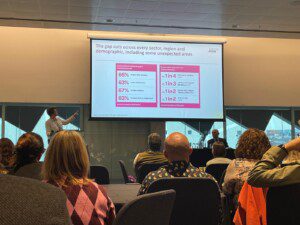
Building on this theme, Gateway Qualifications hosted a session with FutureDotNow to explore the link between inclusion and digital capability. Opening the session, our Commercial Director, Paul Saunders, emphasised that digital skills are now essential for workers to engage with in today’s workplace. FutureDotNow COO Holly Chate shared data showing that 55% of working-age adults lack essential digital skills, illustrating how digital exclusion can compound wider inequalities. The final part of the session, led by Cheryl Swales from AELP, encouraged delegates to reflect and self-assess on how gaps in digital skills can act as hidden barriers to participation and progression.

Assessment Quality and Innovation
Breakout sessions on assessment reform emphasised the need for assessments that mirror real workplace practice, incorporate employer validation and make informed decisions about timing. Innovations such as AI-supported standardisation, digital portfolios and simulation environments were explored, with a clear message that AI should enhance, not replace, professional judgement.
Final Thoughts
The sector is committed to building a skills system that is flexible, inclusive and aligned to future workforce needs. For the Gateway Qualifications team, ATC 2026 was an important opportunity to contribute to sector conversations and share insights from our own work. Our stand gave us the chance to highlight the Corporate Responsibility Practitioner Standard, which continues to attract strong interest, and we were delighted to welcome Spudos, who brought energy and crisps that helped spark many engaging conversations.
We left Liverpool with renewed determination to work in partnership across the sector to help shape an agile, responsive system that supports every learner. Our focus remains on ensuring that learners of all ages can access meaningful, future-focused pathways that enable them to progress and thrive.